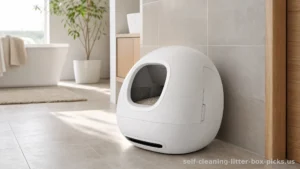
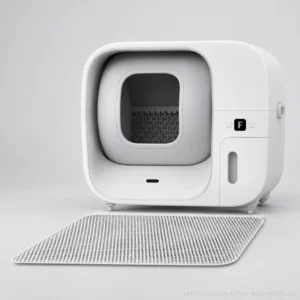
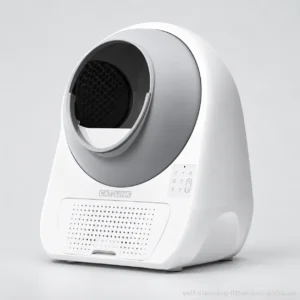
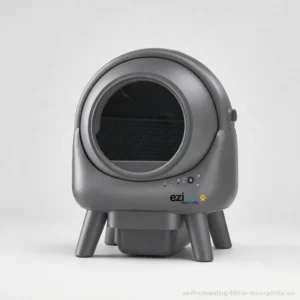
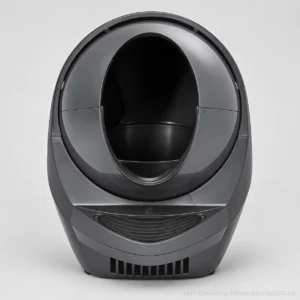
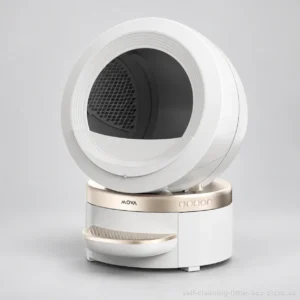
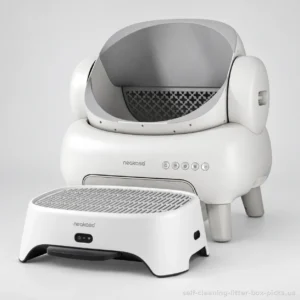
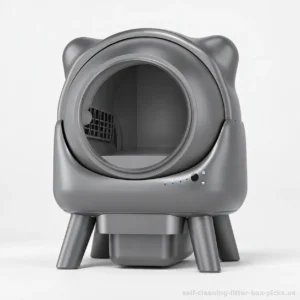
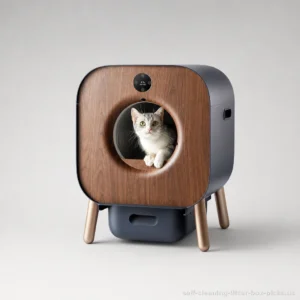
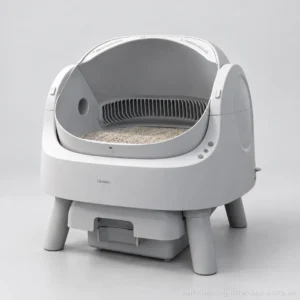
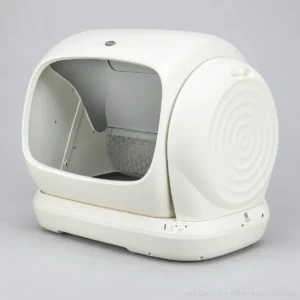
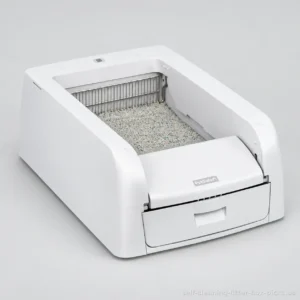
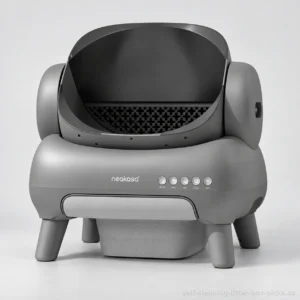
Neakasa M1 Plus
Top-ranked for waste bin capacity and equipment.
Read the review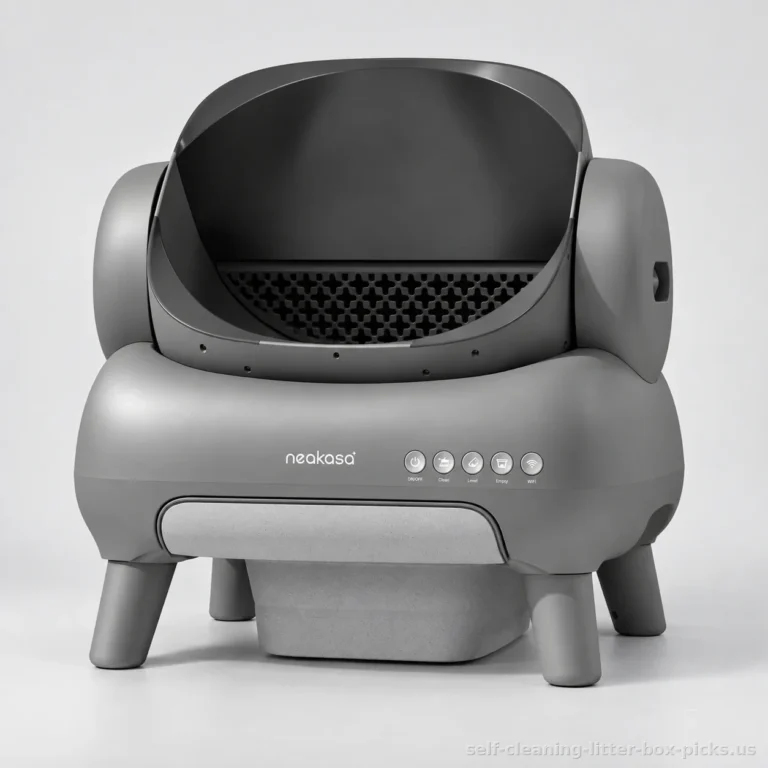 Our rankingsThe best automatic litter boxes30 automatic litter boxes
By size
By cat size
By litter box type
By waste bin capacity
Features and options
Our guides to choosing
This selection analyses the models of self-cleaning litter box on the market, ranked by cleaning mechanism, bin capacity and connectivity, with a buying guide to help you decide.
Prices collected from retailers are for guidance only: they may have changed since, the current price is the one shown by the retailer. No price is shown for models sold only on Amazon. Amounts converted from reference prices in euros using a dated exchange rate.
Top-ranked for waste bin capacity and equipment.
Read the review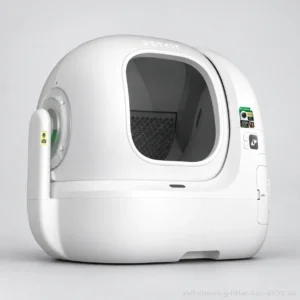
Standout feature: equipment, rated 8.9/10.
Read the review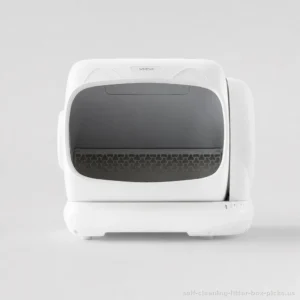
Standout feature: unit weight, rated 8.6/10.
Read the review| Rankings | Score | Price | Minimum cat weight | Maximum cat weight | Usable interior volume | Litter tray capacity | Waste bin capacity | Width | Depth | Height | Entry threshold height | Opening width | Unit weight | Noise level |
|---|---|---|---|---|---|---|---|---|---|---|---|---|---|---|
| 1. Neakasa M1 Plus | 8.9/10 | n/a | n/a | 15 kg | n/a | 7.17 L | 11.23 L | n/a | n/a | n/a | 35.2 cm | n/a | 10.35 kg | n/a |
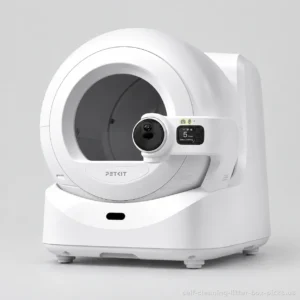
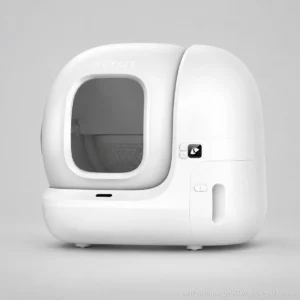
| 2. PETKIT Purobot Max Pro 2 | 8.1/10 | n/a | 1.5 kg | 10 kg | n/a | n/a | 8 L | 65.7 cm | 53.8 cm | 60.3 cm | n/a | n/a | 11 kg | n/a |
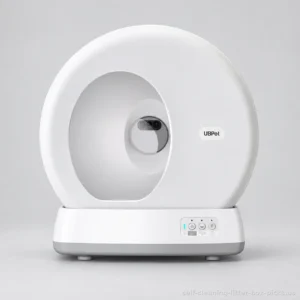
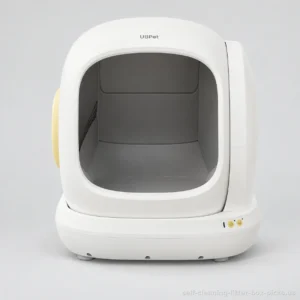
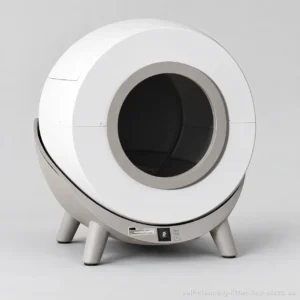
| 3. UBPet C41 | 8.1/10 | n/a | 1 kg | n/a | 106 L | n/a | 6.7 L | 50.8 cm | 63 cm | 57.1 cm | 20.3 cm | n/a | 10 kg | 42 dB |
| 4. PETKIT Purobot Ultra | 8/10 | n/a | 1.5 kg | 10 kg | n/a | n/a | 10 L | 53.2 cm | 81.8 cm | 61.2 cm | 26.5 cm | n/a | 14.6 kg | n/a |
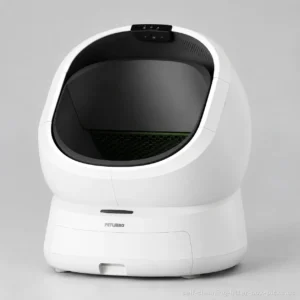
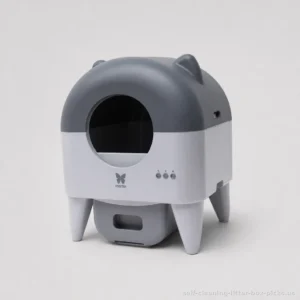
| 5. UBPet C10 | 7.7/10 | n/a | 1.36 kg | 10 kg | n/a | n/a | 5 L | n/a | n/a | n/a | n/a | n/a | 9.5 kg | n/a |
Rankings are based on our review scores, calculated by comparing manufacturer specifications across our entire catalogue.Our methodology.
An automatic litter box is about more than skipping a daily chore. For households where the cat lives indoors, rarely goes outside, or spends most of the day alone, it fundamentally changes how owners approach home hygiene.
The most immediate benefit is the end of manual scooping. The mechanism triggers automatically a few minutes after each visit and directs waste into a sealed compartment. Odors between 2 cleanings are significantly better contained than with a standard litter box.
For owners who are frequently away, the peace of mind is genuine: some models offer a waste drawer capacity of several days without any action needed. Connected models go further by logging visit frequency and the cat's weight at each pass, 2 indicators that can help detect behavioral changes early that may signal a health issue.
3 major types of mechanisms coexist on the market: the linear rake, the globe rotation and the rotating drum. The differences are real:
Long-term durability depends on the quality of the built-in sensors (weight, infrared, anti-pinch) and the number of moving parts. The listed price alone is not enough to assess this.
4 profiles benefit most from an automatic litter box:
That said, for kittens under 6 months old, most manufacturers recommend enabling automatic mode gradually, once the animal is comfortable with the unit.
Before buying, 4 points deserve close attention:
The market in 2026 covers a very wide range, from entry-level models to premium solutions with built-in cameras and health tracking for multiple cats. The following selection reviews the available options and ranks them by usage profile, to help you identify the model that truly fits your situation.
With models spanning a wide price range and very different mechanisms, choosing an automatic litter box calls for solid criteria. Here are the 6 points that truly make the difference, and the mistakes that can prove costly.
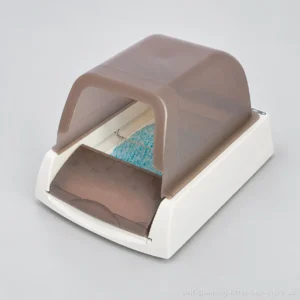
3 main types coexist on the market in 2026. The linear rake sweeps waste into a closed compartment after a fixed delay: the PetSafe ScoopFree Ultra triggers this cycle 20 minutes after the cat's visit, according to its product description. Simple mechanics, low entry price, but poorly suited to lightweight litters that pile up in front of the blade. The sifting mechanism rotates the tray to separate clumps from clean litter, as specified in the UBPet C41's product specifications: more thorough cleaning, but demanding in terms of litter type and quality. Some models feature a semi-open design with a wide entry, making it easier for cats that are reluctant to use enclosed spaces.
Key rule: the more complex the mechanism, the higher the demand for a quality clumping litter. A rotating model exposed to a plant-based litter it was not designed for can jam quickly.
Interior volume and exterior dimensions do not tell the same story. For a cat over 6-7 kg, XXL or extra-large formats are a must. According to manufacturer data, the UBPet C41 features an entry width of 46.7 cm and a threshold of approximately 20.3 cm, suitable for senior or overweight cats. Those looking for the best automatic litter box for large cats should check the interior width first, not the dimensions of the outer shell.
A kitten needs a low threshold and a non-intimidating space. An XXL volume can slow acceptance in young or timid cats.
The bentonite-based clumping litter remains the reference recommended by virtually all manufacturers. Other types come with constraints:
The UBPet C41 claims compatibility with 99.99% of clumping litters (bentonite, tofu, mineral, mixed) according to manufacturer data. Always check the manual before switching litter types, even on a model marketed as versatile.
3 cumulative levers determine real-world effectiveness:
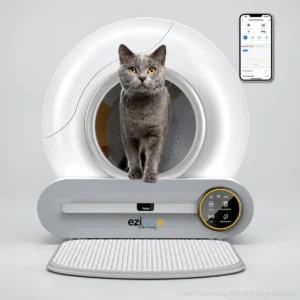
Connected models (HHOLOVE Pro, UBPet C41, PETLIBRO Luma, EZIclean Catbot K10i) allow you to schedule cycles, receive alerts and view visit history. The main value lies in weight and visit frequency tracking: this is the decisive factor when choosing the best automatic litter box with weight sensor rather than a basic model. A behavioral change detected early may warrant a veterinary consultation. The UBPet C41 manages up to 30 cat profiles in the app; the PETLIBRO Luma includes a 1080p HD camera.
What to check before buying: all these models require a Wi-Fi 2.4 GHz. If your router broadcasts on 5 GHz only, you will need to reconfigure your network before installation.
The automatic litter box market spans a wide price range according to our comparison data. But the purchase price is only a starting point:
Mid-range models pack the most useful day-to-day features: a sealed waste drawer, connectivity, and multi-sensor detection. Below that tier, options are limited to simpler mechanisms; above it, the gains come from greater capacity, advanced health tracking, and built-in accessories.
| Model | Listed price | Weight | Dimensions | Size |
|---|---|---|---|---|
| PetSafe ScoopFree Ultra | Check price at retailer | n.d. | . x . x . | n.d. |
| Amicura Cura X1 | Check price at retailer | 7700 g | n.d. | Large |
| HHOLOVE Pro (TY-Pro / CL-TYW) | Check price at retailer | 16,5 Kilograms | 54,5L x 54,5W x 59,5H centimeters | XX-Large |
| Devoko G-SCLB25-1306-2BG | Check price at retailer | n.d. | n.d. | n.d. |
| Petree Cube v2 Black Edition | Check price at retailer | n.d. | n.d. | n.d. |
| UBPet C41 | Check price at retailer | 9.90 kg | 50,8 x 63,0 x 56,9 cm | n.d. |
| EZIclean CATBOT K10i PureSense Edition | Check price at retailer | n.d. | n.d. | n.d. |
| PETKIT Pura Max 2 | Check price at retailer | 9.7 Kilograms | 58D x 53W x 52.5H centimeters | extra-large |
| PETLIBRO Luma | Check price at retailer | 1.5 Kilograms | 60D x 58W x 72H centimeters | Self-Cleaning Cat Litter Box |
| Revo-Loo One | n.d. | 10.4 Kilograms | 57.1D x 53.1W x 58.4H centimeters | XXL |
The comparison above summarizes the key data for each model. Focus first on the entry width and maximum supported weight if you have a large cat, and on the waste drawer capacity if your household has several cats.
An automatic litter box delivers on its promises only when chosen based on your cat's actual profile, not just the product sheet.
No, and this is something to check before buying. Clumping bentonite litter remains the go-to compatible option with the vast majority of models. The UBPet C41 claims compatibility with 99.99% of clumping litters (bentonite, tofu, mineral, mixed) according to manufacturer data. Fine silica litter can jam some drum or rake mechanisms. Always check the list of recommended litters in the manual before buying: a poor choice leads to blockages, false detections, and premature wear.
The basic rule is 1 litter box for 1 to 2 cats. Some models go further: the PETLIBRO Luma is designed for up to 10 cats, with an 11-liter waste drawer lasting up to 7 days for 2 cats according to manufacturer data. The UBPet C41 manages up to 30 profiles in its app. Beyond 3 cats, the drawer volume and emptying frequency become the truly decisive criteria, far more than the stated capacity.
The noise is brief (a few seconds per cycle) but varies depending on the mechanism. The only documented value in the analyzed data concerns the PETLIBRO Luma: 35 to 47 dB according to the manufacturer, equivalent to a quiet conversation. Other models do not provide a decibel figure in their product sheets. If your cat uses the litter box at night or your living space is small, the placement of the unit is worth considering before installation.
This varies significantly from one model to another. The PetSafe ScoopFree uses a ready-to-use disposable removable tray, which means recurring brand-specific purchases. Other models use replaceable activated carbon filters, such as the PETLIBRO Luma. Before buying, identify whether the consumables are proprietary or standard, their unit price, and how often they need replacing: this is often where the real cost difference over 2 years between 2 models lies.
Not necessarily. The PETKIT Pura Max 2 is explicitly recommended for cats older than 6 months according to manufacturer data. Below this threshold, weight sensors may fail to detect a kitten that is too light, creating a risk that the mechanism activates while the kitten is still present. The UBPet C41 claims a range starting from 1 kg, but an active monitoring phase at the start is recommended for any young cat, regardless of the model.
The 2 most common technologies are weight sensors and infrared sensors. The Amicura Cura X1 combines 4 weight sensors and 2 infrared sensors to detect presence in real time, according to manufacturer data. The HHOLOVE Pro uses 4 weight sensors. A safety delay is then applied before activation: 20 minutes on the PetSafe ScoopFree, according to its product sheet. This delay prevents any cleaning while the cat is present.
For large-framed or overweight cats, prioritize the maximum accepted weight and the internal volume. The UBPet C41 claims a limit of around 15 kg with 106 liters of internal volume and an entry width of 46.7 cm according to manufacturer data. The Devoko accepts up to 10 kg, and the HHOLOVE Pro offers an XXL format (54.5 × 54.5 × 59.5 cm). By contrast, the Amicura Cura X1 is limited to 8 kg and should be ruled out for heavier cats.
No manufacturer data guarantees a precise timeframe, and individual profiles vary from one cat to another. Feedback points to a few days to a few weeks for the majority of cats. The most effective transition involves placing the new litter box next to the old one, with the cleaning mechanism disabled at first. Senior cats, anxious cats, or those used to an open tray generally require a longer adjustment period.