Best self cleaning litter box with an open tray 2026, picks and comparison
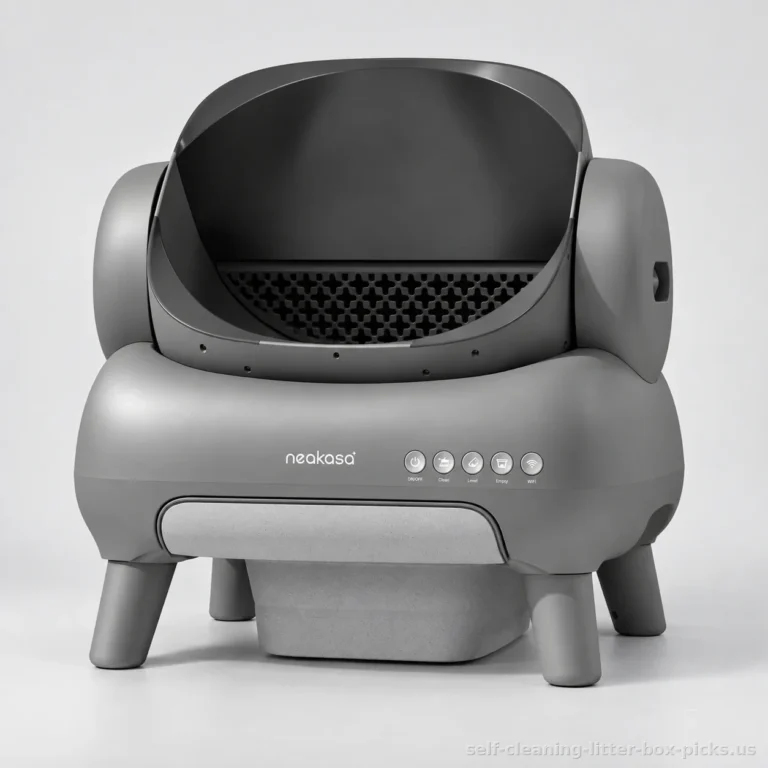
Will your cat have enough room in an open tray? The Best open-top automatic litter box should provide enough usable space for your cat’s size and documented safety features.
Answer a few questions in 10 seconds4 questions about the 5 models in this selection
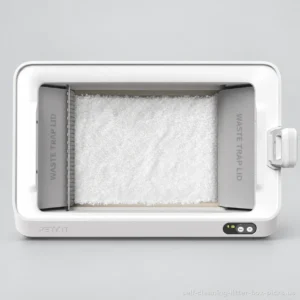
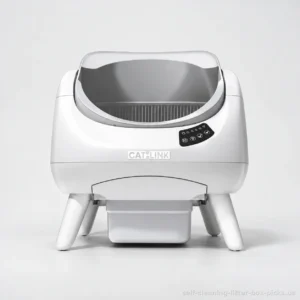
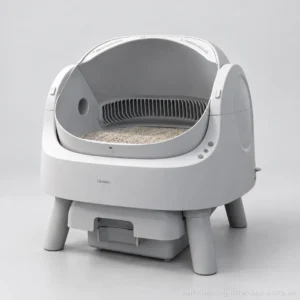
Prices collected from retailers are for guidance only: they may have changed since, the current price is the one shown by the retailer. No price is shown for models sold only on Amazon. Amounts converted from reference prices in euros using a dated exchange rate.
Our selection criteria
- 5 models shortlisted because they have the feature “Open tray” according to data published by manufacturers and retailers.
- See how we rank →
- No brand pays to be included in this selection or to rank higher.
Why choose an open-top automatic litter box?
What is an automatic litter box with an open tray?
The best automatic litter box with an open tray is one that suits your cat’s size, offers comfortable access and has documented safety conditions. Its appeal lies in keeping the space open while automating waste removal.
An open tray has no cover above it. It differs from an enclosed housing with a front entrance, even a wide one. This distinction matters for a cat that prefers to watch its surroundings or stand upright without a roof getting in the way.
This snapshot does not represent the entire market. If you are looking for an affordable automatic litter box, include consumables and replacement parts in your comparison too.
Which cats might an open tray suit?
An open self-cleaning litter box is worth considering if your cat already uses an uncovered tray or seems uncomfortable in an enclosed litter box. Having no roof may give your cat more freedom to adopt its usual position. However, it guarantees neither enough space nor that your cat will use it.
- For a large cat, check the space available to enter, turn around and dig.
- For a cat with reduced mobility, prioritise a suitable entry height. An open top does not necessarily make access easy.
- For a cat that is sensitive to change, plan a gradual transition while keeping its usual tray available.
In a household with several cats, needs may differ. The same tray will not necessarily suit every cat. The detection conditions and usage limits stated in the instructions remain key.
What difference does automatic cleaning really make day to day?
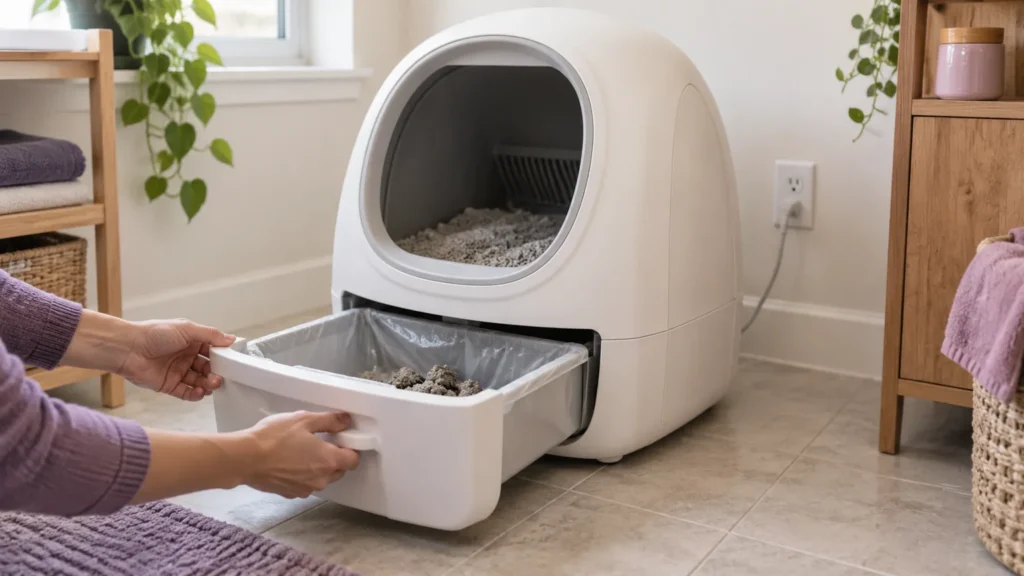
The expected benefit is simple: less manual scooping between your cat’s visits. Depending on the documented mechanism, waste is separated from reusable litter and then directed into a waste compartment. The litter used must be compatible with this process.
This assistance may appeal to people who want to reduce a repetitive chore. However, it still leaves some essential manual maintenance:
- Empty the waste compartment and replace its bag when necessary.
- Top up the litter to the specified level.
- Clean soiled surfaces and washable components.
- Monitor the condition of the mechanism and sensors as directed in the instructions.
Automation therefore does not remove the need to check the tray’s cleanliness and proper operation every day.
What compromises come with an open tray?
Without a lid, waste remains visible until it is removed. Scattered litter and urine going over the sides are also points to consider, depending on your cat’s habits. High sides may help, but they do not solve every situation.
For odours, focus on how well the waste compartment seals and how easy it is to clean. An open tray does not guarantee that odours will disappear; an enclosed tray still needs maintenance too. Finally, an open design alone does not guarantee the safety of the automatic movement.
The selection on this page will help you compare these criteria against the documented specifications of the models featured. Prioritise usable space, access and safety instructions over extra features.
How to choose your open-top automatic litter box
To choose the best automatic litter box with an open tray, prioritize usable space, ease of access and documented safety features. Connected features come next. Check that the top stays open while your cat uses it: an enclosure with a front entrance does not meet the same need.
How can you check whether your cat will have enough room?
Distinguish between the external dimensions and the usable tray area. The former help you plan where to put it; the latter lets you assess the room available for turning around, digging and squatting. If the listing only gives the appliance’s overall size, ask for the internal dimensions before ordering.
Compare these measurements with those of the tray your cat uses comfortably. A stated maximum weight is not enough to establish whether a long or heavily built cat will be comfortable. For an automatic litter box for large cats, freedom of movement matters more than an overall capacity expressed in liters.
- Check the entry height if your cat struggles to step over edges.
- Examine the wall height if your cat urinates standing up or digs vigorously.
- Allow enough space to access the waste container and remove the components.
What safety assurances should you check before buying?
An open tray alone does not guarantee safe cleaning. Consult the manual to identify detection conditions, weight and age restrictions, and how the unit should respond when a cat returns during a cycle.
The documentation should explain what triggers movement, what stops it and the conditions for resuming it. Simply mentioning “safety sensors” does not help distinguish between appliances. If you cannot find this information, rule out the model for now.
For a kitten, explicitly check whether it meets the requirements for automatic operation. In a household with several cats, also look for instructions covering visits in quick succession and another animal approaching during cleaning. Every cat must meet the conditions of use.
Which litter suits the chosen mechanism?
Start with the manual, then check the permitted material, grain size, clumping requirements and fill level. Do not assume your usual litter is suitable just because it works in a conventional tray.
Incompatible litter can interfere with waste separation or encourage buildup. Depending on the mechanism, you should therefore check how well clumps hold together and how the grains pass through the separation system.
Before buying, check whether your usual retailers stock compatible supplies. A readily available product makes maintenance easier. If your cat struggles to adjust to changes in litter material, make compatibility a priority.
How can you assess odors and maintenance needs?
Automatic scooping does not replace manual cleaning. You will still need to empty the waste container, top up the litter and wash the components permitted by the manual. Examine how accessible they are rather than relying on a general promise of hands-free operation.
- Check how the waste container closes and how the bag is removed.
- Look for corners, edges and areas where waste could accumulate.
- Identify which parts are removable and which can be washed.
- Check whether any filters need replacing and whether they are readily available.
The stated capacity of the waste container is not enough to determine how often your household should empty it. Monitor how full it is and any odors. When installing it, follow the manual’s requirements for flooring, clearance and power supply. Near a bedroom, look for documented information on noise and scheduling options.
How much should you budget for purchase and running costs?
The available data does not provide a reliable price range for open-top litter boxes. Compare offers available at the time of purchase, factoring in the cost of consumables and parts, rather than focusing solely on the advertised price.
For each device, check the costs of compatible litter, required bags and any filters. Also check the availability of replacement parts. A search for a cheap automatic litter box should account for these recurring costs.
Read the warranty and return terms before ordering, particularly those concerning a device that has been used. Check who pays for return shipping and how to contact after-sales support.
How do you choose between models for your situation?
Use this table to prioritise your needs. Missing information remains something to check, never an assumed advantage. Without sufficiently documented specifications, recommending specific models would not be justified.
| Criterion | What to look for | Common mistake |
|---|---|---|
| Large cat | Usable space that allows the cat to turn around comfortably | Relying solely on the maximum weight |
| Reduced mobility | Accessible entrance and an unobstructed approach | Confusing an open top with easy access |
| Small home | Overall dimensions that allow access to the waste container | Measuring only the floor space |
| Multiple cats | Detection requirements suited to each animal | Choosing solely based on a large waste container |
| Maintenance | Accessible soiled components and readily available consumables | Assuming cleaning is no longer necessary |
Mistakes to avoid
- Confusing total capacity with the space available for the cat.
- Assuming automation solves splashing or urination over the sides.
- Buying without checking the manual and return policy.
- Replacing the usual litter box immediately. Keep it accessible during the transition and gradually enable automatic operation, following the manual.
Key takeaways
Choose the litter box whose verified features match your cat’s habits. Then compare the models based on maintenance, consumables and after-sales service. An extra feature cannot make up for difficult access or inadequately documented safety provisions.
Your questions about open-top automatic litter boxes answered
What is the best open-top automatic litter box?
The best open-top automatic litter box provides enough room for your cat, suitable access and clearly documented safety requirements. An open top alone does not guarantee comfort or safety. Compare the usable space, entry height and detection limits specified in the manual. Without verified specifications for each model, our analysis cannot identify a winner.
What is the best litter for an automatic litter box?
The best litter is one explicitly listed as compatible in your device’s manual. Clumping litter does not necessarily work with every mechanism. Check the permitted material, granule size and required fill level. Compatibility with the mechanism matters more than marketing claims. Unsuitable litter can make waste separation harder or clog moving parts. When switching litter, also take your cat’s habits into account.
What benefits and limitations can you expect from an automatic litter box?
An automatic litter box can reduce daily scooping, but it does not eliminate manual maintenance. You still need to empty the waste compartment, top up the litter and wash the parts according to the manual. With an open-top box, pay particular attention to the risk of litter scattering and urine going over the sides. Odour control also depends on waste storage and surface cleanliness. No detailed user feedback provided here allows us to compare the models’ reliability.
What is the most effective cat litter?
The most effective litter is one your cat readily uses and that allows you to remove waste properly. In an automatic litter box, it must also meet the mechanism’s requirements. Compare absorbency, dust levels and, where clumping is required, how well the clumps hold together. Scent alone is not a measure of effectiveness. To keep costs under control, a search for a “cheap automatic litter box” should also factor in the cost of compatible litter and consumables.
Is an open-top automatic litter box suitable for a large cat?
Yes, an open-top automatic litter box can suit a large cat if the usable space allows it to turn around and adopt its usual posture. The absence of a roof does not make up for a base that is too narrow. The stated maximum weight does not prove that the box will be comfortable. To choose an automatic litter box for large cats, compare the documented internal dimensions with those of the box your cat already uses, then check the side height and access.
Can you use an open-top automatic litter box with a kitten?
Only if the manual permits use for your kitten’s age and weight, under the conditions specified by the manufacturer. An open top does not guarantee that your kitten will be detected. Check the sensors’ limits and the instructions on triggering the cleaning cycle. If this information is missing or your kitten does not meet the requirements, choose a conventional litter box. Do not improvise manual operation or disable safety features without a procedure explicitly provided in the manual.
Can an open-top automatic litter box suit multiple cats?
Yes, provided every cat can use it comfortably and meets the manufacturer’s detection requirements. Also check the instructions for when an animal approaches during cleaning. The waste compartment’s capacity alone does not determine suitability for your household, as visits and waste add up. Plan for regular checks and keep other litter boxes available. Automation does not resolve any conflict between cats over the box.
How do you get a cat used to an open-top automatic litter box?
Introduce it gradually, keeping your cat’s usual litter box during the transition. Place the new box in a quiet, accessible location with compatible litter, then let your cat explore it without forcing it. If the manual provides an acclimatisation period without automatic cycles, follow that procedure. Then introduce operation according to the manufacturer’s instructions and observe your cat’s reaction to the movement and noise. Do not remove the old litter box while your cat is still hesitant about using the new one.