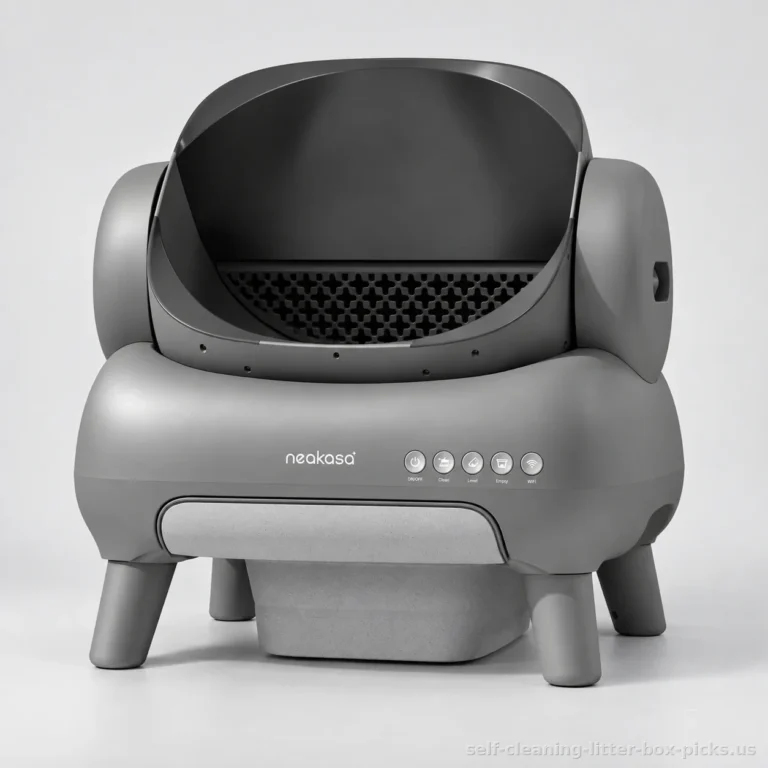
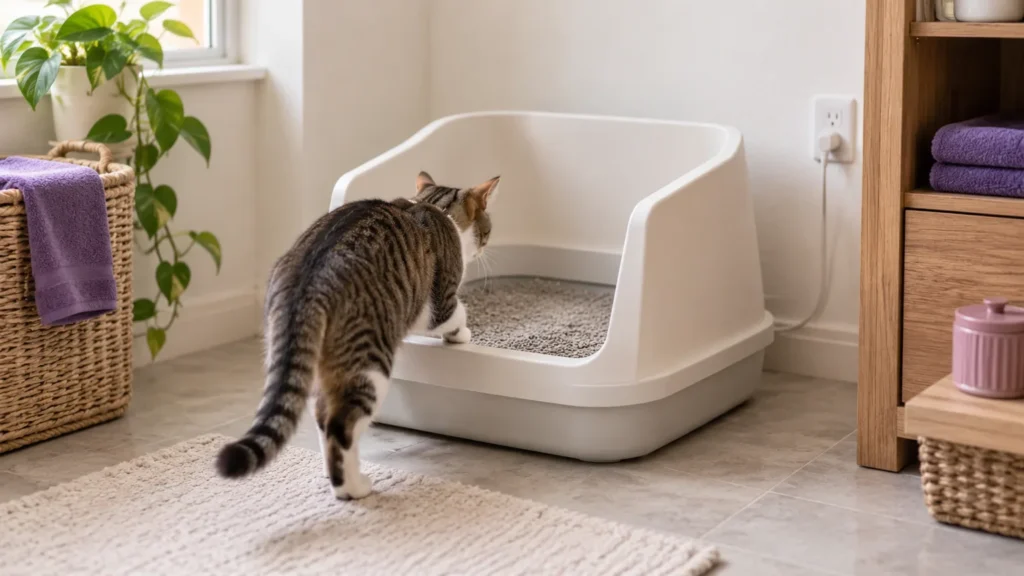
Best self cleaning litter box with a partially enclosed tray 2026, picks and comparison
Will your cat accept a partially enclosed litter box without avoiding it? This selection of models in our best semi-enclosed automatic litter box comparison helps you decide before buying.
Prices collected from retailers are for guidance only: they may have changed since, the current price is the one shown by the retailer. No price is shown for models sold only on Amazon. Amounts converted from reference prices in euros using a dated exchange rate.
Our selection criteria
- 2 models shortlisted because they have the feature “Partially enclosed tray” according to data published by manufacturers and retailers.
- See how we rank →
- No brand pays to be included in this selection or to rank higher.
Why choose a semi-enclosed automatic litter box?
A semi-enclosed litter box addresses a very practical problem: litter scattered outside the box and odours spreading through the room. Unlike a fully open box, its high sides catch litter kicked up during scratching and reduce the amount scattered across the floor. Unlike a fully enclosed box with a complete cover, it lets the cat retain a partial view of its surroundings, reassuring animals that dislike feeling trapped in an enclosed space. This middle ground explains the format's popularity compared with a conventional automatic litter box with an open tray, which is less effective at controlling odours, or a fully covered enclosure, which more timid cats can find unsettling.
The balance between discretion and your cat's comfort
A semi-enclosed litter box will not suit every cat equally. An animal that has used an open box for years may take several days to accept higher sides, while a kitten or a cat already accustomed to covered spaces will often adapt easily. 2 points deserve particular attention before buying: the entry height, which must remain manageable for an older cat or one with limited mobility, and the feeling of confinement, best avoided by choosing a model with a wide opening and sufficient overhead clearance. The aim is never to block the cat's view completely, but to contain scattered litter and odours without causing stress.
How a semi-enclosed litter box changes everyday use
In everyday use, this format mainly changes 2 maintenance habits. First, the sides, however high, need regular cleaning because they collect some of the residue that an open box would simply let fall onto the floor. Second, odour control between 2 emptying sessions becomes more effective because the semi-enclosed box limits the spread of smells through the room, a clear advantage in a living room or studio flat where the appliance is always on view. This balance makes particular sense in small spaces: open enough to avoid stressing the cat, enclosed enough to keep smells from filling the entire home.
In terms of budget, this type of automatic litter box generally sits between the entry-level and premium ends of the market, depending on its features (mobile app, sensors, filtration). The most affordable models offer the essentials of the semi-enclosed design, while more fully equipped versions add connectivity and advanced automation. The selection below details the models that best balance odour containment, your cat's comfort and ease of maintenance.
How to choose the right semi-enclosed automatic litter box
A semi-enclosed litter box makes a real difference compared with an open model, but it comes with its own selection criteria. Here are the factors that really make the difference between a satisfying purchase and an automatic litter box sold on 6 months later.
How to check suitability for your cats' size and how many you have
A semi-enclosed litter box offers less internal space than an open litter box with the same external dimensions. Before buying, compare the internal drum dimensions with your cat's actual size, not just its weight. A large cat needs to be able to turn around and scratch without touching the walls, or it may develop an aversion to the device.
For a household with several cats, consider an automatic litter box with a weight sensor that can distinguish between individual animals and adjust the cycles accordingly. This type of sensor also excludes cats that are too light (kittens) or triggers an alert if a cat exceeds the manufacturer's specified threshold, protecting both the animal and the mechanism.
How much noise to expect from a mechanism in a semi-enclosed space
The side walls and cover of a semi-enclosed litter box tend to amplify motor noise rather than muffle it, contrary to popular belief. Raking and drum rotation resonate more in a confined space than in an automatic litter box with a completely open tray.
2 points to check every time: the option to disable the automatic cleaning cycle at night (to avoid waking the household or startling a cat passing nearby), and a long enough delay after use to let the cat move away before the cycle starts.
What waste compartment capacity and emptying interval to expect
The interval between emptying advertised by manufacturers almost always assumes use by a single cat. In a household with several cats, the actual emptying frequency rises quickly, regardless of the waste compartment's volume. You should therefore think in terms of the number of visits per day per cat, not just litres.
The size and availability of waste bags also matter: a proprietary system limits your choice and can increase running costs over time, whereas a compartment compatible with standard bin bags offers more flexibility.
How to assess how easy a semi-enclosed litter box is to clean and maintain
This is the most frequently overlooked point. Enclosed walls create hidden corners where litter and odours accumulate, especially where the cover meets the drum. A good model has walls that can be removed without tools, direct access to the drum for thorough cleaning, and materials that do not retain odours (smooth rather than textured surfaces).
Thorough weekly maintenance is still necessary even with a daily automatic cycle: the sensor, drum and infrared or weight sensors need to be kept free of dust to work properly over time.
How much to budget for the features you need
Automatic litter boxes with a semi-enclosed design generally range from entry-level to premium connected models. Here is what each tier offers in practice, with the aim of finding the model that meets your household's actual needs rather than the cheapest option.
| Product tier | What you get | Limitations to consider |
|---|---|---|
| Entry-level | Basic automatic cycle, simple semi-enclosed box, manual litter top-ups | Few or no weight sensors, limited time between maintenance in multi-cat households |
| Mid-range | Weight or infrared sensor, app monitoring, customisable cycle settings | Noise may still be noticeable at night |
| High-end | Advanced odour filtration, full connectivity, precise identification of individual cats, full waste bin alerts | Often takes up more floor space |
Mistakes to avoid
- Underestimating your cat's size relative to the actual interior space of the semi-enclosed box, rather than its advertised external dimensions.
- Overlooking noise levels by failing to check whether overnight cycles can be disabled, especially in a studio flat or near a bedroom.
- Forgetting the space needed around the unit to allow the panels to open for cleaning and let your cat enter without feeling cramped.
- Choosing solely on the advertised time between maintenance without accounting for the actual number of cats in your household.
- Ignoring litter compatibility: some semi-enclosed boxes require a specific granule size for the sensor and sifting mechanism to work properly.
- Going straight for an XXL automatic litter box without checking that the available floor space and your home's entrance doorway can accommodate it.
Key takeaways
A semi-enclosed box is only a good choice if 3 requirements are met: suitable interior space to the cat's size, a manageable noise level thanks to cycles that can be disabled at night, and straightforward maintenance despite the enclosed sides. For a household with several cats, choosing a reliable weight sensor and a generous waste collection capacity helps avoid unpleasant surprises. The budget should reflect the features that are actually useful, not the other way round: a well-maintained mid-range model is a better choice than a high-end model that is the wrong size for the household.
What you want to know before buying a semi-enclosed litter box
Is an automatic litter box with a semi-enclosed tray suitable for a nervous cat
A semi-enclosed tray is often a good compromise for a nervous cat: the partial walls limit litter scatter and visual exposure without creating the confined feeling of a fully enclosed hood. A very anxious cat or a cat unfamiliar with the machine may still feel more comfortable with an automatic litter box with an open tray while it gets used to it. It is best to observe its behaviour during the first few days and keep a conventional litter box nearby if needed.
What is the difference between a semi-enclosed tray and a fully enclosed tray
A semi-enclosed tray has a wide opening or a partial hood that allows the cat to see out and leave freely, whereas a fully enclosed tray surrounds the cleaning area with a complete hood, often combined with air filtration. A semi-enclosed tray is better at containing odours and litter scatter than a conventional open tray, while remaining less stressful than a fully enclosed model for cats sensitive to confinement.
Is a semi-enclosed automatic litter box quieter than an open tray
Not necessarily: the walls of a semi-enclosed tray can actually amplify the noise of the mechanism by reflecting it within a more enclosed space. The actual noise level depends mainly on the motor technology and the materials used, rather than just the shape of the tray. For a living room or bedroom, it is best to check whether the device offers a quiet mode or an option to disable cleaning cycles at night.
How long can an automatic litter box with a semi-enclosed tray run without intervention
The time between maintenance tasks quoted by manufacturers often assumes use by a single cat under ideal conditions. In practice, it mainly varies according to the capacity of the waste compartment and the number of cats in the household: with several cats, more frequent emptying is needed to prevent overfilling. It is best to treat the stated intervals as a theoretical maximum rather than a guarantee of daily use without supervision.
Can an automatic litter box with a semi-enclosed tray be used by several cats
Yes, provided you check the capacity of the waste compartment and whether the device is suitable for use by several cats. To complement automatic sifting in this setting, an automatic litter box with a weight sensor allows kittens or animals that are too light to be excluded from the cleaning cycle. For a large cat, an automatic litter box for large cats remains preferable to ensure enough room in the semi-enclosed tray.
What type of litter should you use with a semi-enclosed automatic tray
Manufacturers generally recommend fine-grained clumping litter, with grains sized to avoid blocking the sifting mechanism or damaging the tray walls. Litter with large granules or excessive dust is often discouraged, as it can interfere with the sensor or accumulate in the enclosed corners of a semi-enclosed tray. Following the manufacturer's recommendations remains the safest approach.
How to clean an automatic litter box with a semi-enclosed tray
Maintenance involves regularly replacing the waste bag, cleaning the drum or sifting platform, and wiping the side walls, where residue tends to accumulate in enclosed corners. A weekly clean with lukewarm water and mild soap, with the device unplugged, helps limit lingering odours and protect the weight sensor over time.
Does a semi-enclosed automatic litter box really contain odours better
Its partial walls limit the spread of odours better than a fully open tray, but less effectively than a fully enclosed model fitted with an active air filtration. Actual odour containment also depends on how often the collection bag is emptied and the type of litter used. Without regular maintenance, even a partially enclosed litter box will eventually let odours escape over time.